

Central African Republic Facing Threat of Partition
A new policy brief published today by the Enough Project concludes that leaders of armed groups in the Central African Republic (CAR) are deliberately stoking sectarian violence and threats of a national break-up in an attempt to further personal and corrupt self- interests ...
Dangerous Divisions: The Central African Republic faces the threat of secession
The Central African Republic (CAR), a country that has seen more than four years of deep political crisis and unprecedented violence against civilians, is undergoing a process of de facto partition. In February 2014, then-U.N. Secretary-General Ban Ki-moon warned the international community that CAR was at risk of splitting apart, stating that, “[T]he situation continues to worsen. Both Muslims and Christians have been murdered and forced to flee their homes. The sectarian brutality is changing the country’s demography. The de facto partition of the CAR is a distinct risk.” Despite his warning, CAR did not escape this fate. In 2017, ...
2017 Conflict Minerals Company Rankings
This Valentine’s Day the Enough Project is excited to announce we will once again be ranking leading companies on their efforts to source conflict-free minerals from Congo. With the Dodd-Frank 1502 conflict minerals law under increasing threat of being repealed or weakened, this consumer holiday is the perfect time to let companies know we expect a strong commitment to conflict-free sourcing ...
UN Report Confirms Prevalence of War Economy in Central African Republic
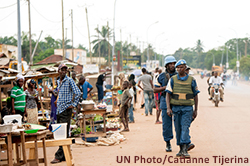
In its final report for 2016 released in December, the U.N. Security Council’s Panel of Experts on the Central African Republic (CAR) confirmed that the trafficking of arms and natural resources continues to be central in the perpetuation of violence in the country ...
UN Report Reaffirms Alarming Security Situation in Central African Republic
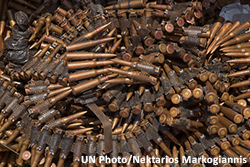
The U.N. Security Council’s Panel of Experts on the Central African Republic (CAR) released its final report for 2016 in December. The 186-page report documents a sharp deterioration in the security situation and a deepening crisis in CAR since August 2016. The country continues to be ruled by a multitude of criminal gangs that fiercely compete for control of economic resources ...
Enough Project Statement on U.S. Refugee Policy
The Enough Project is dedicated to ending genocide and crimes against humanity in East and Central Africa, including in Sudan and Somalia. A key aspect of combating these atrocities is to ensure protection of innocent people fleeing this violence, especially when the governments responsible for protecting their civilians either cannot, or will not, do so ...
Enough’s 5 Recommended Reads | Feb. 9
Enough's 5 Recommended Reads is a biweekly series featuring important stories you may have missed ...
New Analysis Shows Costs for U.S. Companies to Implement Conflict Minerals Law 74-85% Lower than Expected

On February 6th, Elm Sustainability Partners, an independent advisory firm, published detailed information demonstrating that implementation costs related to federal conflict minerals reporting requirements for businesses have been substantially lower than expected and U.S. companies have in fact seen “tangible business benefits.” ...
Fox News Op-ed: Congo’s Violent Kleptocracy at a Crossroads
At fifteen minutes to midnight on New Year’s Eve, early fireworks went off in the Democratic Republic of Congo. These weren’t to celebrate another new year, but rather the signing of an agreement that, if implemented, paves the way for the country’s first ever peaceful, democratic transition of power ...
Missing the Point on South Sudan
On January 18, Ambassador Donald Booth took the stage at the United States Institute of Peace to reflect on his tenure as U.S. Special Envoy to Sudan and South Sudan. During this discussion, Booth’s mention of the missed opportunities for meaningful action early in South Sudan’s civil war was noticeably absent. While lamenting miscalculations regarding the selfish ways of the country’s political leaders and wondering how the new administration could “incentivize” peace, he failed to reflect on what might have been the administration’s most consequential decision . . . or lack thereof ...
