

Enough Project Statement on U.N. Investigators Killed in the Democratic Republic of the Congo
The Enough Project is deeply saddened by the deaths of United Nations Group of Experts investigators Michael Sharp and Zaida Catalán and their interpreter, Betu Tshintela. Their driver, Isaac Kabuayi and two unidentified motorbike drivers traveling with the group are still missing. We extend our condolences to all of their families and colleagues ...
New “Enough Forum” Report – “A Way Out?”
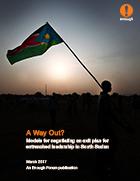
Today, the Enough Forum published a new paper “A Way Out? Models for negotiating an exit plan for entrenched leadership in South Sudan.” The author of the paper, whose name remains confidential due to security reasons, states that the outbreak of conflict in Juba, in July 2016 rendered the August 2015 Agreement on the Resolution of the Conflict in South Sudan (ARCSS) dead, as one of the principal signatories of the agreement former First Vice President Riek Machar fled the country ...
Enough’s 5 Recommended Reads | Mar. 23
Enough's 5 Recommended Reads is a biweekly series featuring important stories you may have missed ...
John Prendergast Speaks on Famine in South Sudan
Enough Project's Founding Director John Prendergast spoke to Channel 4 News this week about the devastating famine in South Sudan ...
Daily Beast Op-ed: Corrupt Leaders Thrust South Sudan Into Famine and Abject Ruin
A legacy of corruption and violence has finally caught up to South Sudan, the world’s newest country, as the United Nations has declared a full-blown famine, a rare designation not made for any part of the world since 2011. Multiple UN officials have additionally warned that the country, riven by armed conflict, stands on the brink of genocide ...
CBS 60 Minutes Segment on South Sudan

On Sunday, March 19, 2017, CBS 60 Minutes featured a powerful segment on how the world is responding to the ongoing humanitarian crisis in South Sudan. Enough Project Founding Director John Prendergast was in South Sudan when 60 Minutes correspondent and CBS Evening News anchor Scott Pelley was doing the story, and Pelley interviewed Prendergast there on the root causes of the crisis. Learn more: Read this Washington Post op-ed "South Sudan's Government-made Famine" by The Sentry co-founders George Clooney and John Prendergast. Clooney and Prendergast note that this is not only a 'man-made' famine, but in fact a 'government-made' one, with the backdrop of ...
Despite Assurances, South Sudanese Government Continues to Impede Aid Efforts
Last month, the United Nations declared famine in parts of South Sudan with 100,000 people currently facing starvation and a further one million on the brink of famine. Despite such alarming reports, South Sudan’s government has put up roadblocks impeding international humanitarian aid efforts trying to reach those severely affected by the crisis. A recent report by the U.N. Office for the Coordination of Humanitarian Affairs stated that “Aid workers continue to face multiple obstacles to the delivery of humanitarian assistance across South Sudan, including active hostilities, access denials, and bureaucratic impediments.” ...
Washington Post Op-ed: South Sudan’s Government-made Famine
Official, U.N.-declared famines are a rare phenomenon. The last one worldwide was six years ago, in Somalia. Famines are declared officially when people have already begun to starve to death. It is the diplomatic equivalent of a seven-alarm fire. That is where the youngest country in the world, South Sudan, finds itself today, as 100,000 face immediate starvation and another 1 million are on its brink ...
Enough’s 5 Recommended Reads | Mar. 9
Enough's 5 Recommended Reads is a biweekly series featuring important stories you may have missed ...
Marking International Women’s Day 2017
Like many around the globe, women across crisis zones in east and central Africa are subject to sexual and gender-based violence. In the Democratic Republic of Congo particularly, SGBV is a disturbing feature of the country’s decades-long conflict as it is continually used as a weapon of war. Today, on International Women’s Day, the Enough Project is highlighting the vulnerable security situation for the women in eastern Congo’s mining areas ...
