

The world’s deadliest war and most pronounced use of rape as a weapon continue to rage in the eastern Democratic Republic of the Congo. For 13 years, the people of eastern Congo have been ensnared in a tangled web of armed groups—from foreign rebels to the Congo’s own army—who prey on Congolese civilians and, with collaboration from governments and multinational corporations, strip the country of its immense natural wealth. This conflict can only end when the international community abandons the piecemeal approach it has adopted to deal with this multilayered and immensely complex conflict and takes a holistic approach to peacemaking.
A revamped approach requires a careful combination of all the tools available to policymakers, from aggressive multilateral diplomacy and conditioned foreign assistance to targeted sanctions and, in rare cases, carefully planned military action. Yet it is abundantly clear that generating the political will to leverage these tools effectively also requires action from activists and concerned citizens. Congo’s stain on our collective conscience is deep, but so too is the connection between our daily lives and those of Congolese people fighting to break the cycle of conflict and misery. Citizen pressure on policymakers and the corporations that benefit from the trade in conflict minerals—including American and European cell phone, laptop, and jewelry manufacturers—is a critical element of a worldwide effort to end the crisis in eastern Congo once and for all.
Tragically, the international community spends well in excess of $2 billion a year treating the symptoms of the Congolese crisis through international peacekeeping and humanitarian assistance. By our calculations, roughly one-tenth of one percent of what we spend on aid and peacekeepers is spent on dealing with what has become a principal driver of conflict in Congo: the trade in conflict minerals.[ii] Mineral wealth did not cause the war in Congo, but it sustains armed combatants and fuels ongoing atrocities. Just as with the “blood diamonds” of Sierra Leone and Angola, until there was a change in the way the world purchased diamonds, there was little chance for peace in those countries. Similarly, there will be little chance for peace in Congo until the world figures out a way to purchase that country’s minerals without fueling horrific violence.
Startlingly, most diplomatic efforts seem not to acknowledge that the conventional image of Congo as a failed state is at variance with a dark and little-acknowledged reality: that the Congolese government often promotes insecurity and lawlessness to allow its top officials to enrich themselves in the illegal smuggling of Congo’s natural resources. Nor do policymakers fully acknowledge the continuing role that neighboring governments—particularly Rwanda and Uganda—play in fuelling violence and profiteering from Congo’s state weakness and chronic conflict. Overcoming this policy blind spot and tackling the underlying complexities of the crisis head on requires a paradigm shift for policymakers under pressure from informed and concerned consumers and activists.
The situation in eastern Congo is poised to get much worse in the coming weeks and months. A new offensive by the Congolese government army, backed by United Nations peacekeepers, against Rwandan FDLR rebels based in North and South Kivu,[iii] has predictably led to a major spike in human rights violations, in particular violence against women and girls, the abduction of children as soldiers or sex slaves, the burning of houses or entire villages, and the systematic looting of civilians. As the saying goes, “when you are in a hole, stop digging.” The international community should call on the Congolese government to suspend the operation and work with it and key actors in the region to adopt a new approach that focuses on five basic tasks: protecting civilians, implementing an effective counterinsurgency strategy against the Democratic Forces for the Liberation of Rwanda, or FDLR, ending the trade in conflict minerals, promoting regional peace and economic cooperation; and, promoting accountability.
Eastern Congo aflame
The situation on the ground remains catastrophic. The humanitarian crisis has deepened dramatically in the Kivus, with at least 400,000 newly displaced by the operation since the beginning of 2009, due primarily to the wanton criminality of Congolese forces deployed for these operations and vicious counter-attacks on civilians by the FDLR.[iv] An equally appalling situation has unfolded in northeastern Orientale Province, where the Ugandan Lord’s Resistance Army, or LRA, continues brutal attacks on civilians in the aftermath of a failed Ugandan-led offensive.[v]
Clearly, the current international approach to the crisis in eastern Congo, and indeed the Great Lakes region more broadly, is failing. And the cost of this failure is disastrous for civilians living on eastern Congo’s 500 mile long battlefield.
Congo and Rwanda: A delicate détente
On the surface, there has been a sea change in Congolese and regional politics as a result of the unprecedented deal struck between the Rwandan and Congolese governments late last year. The agreement led directly to the arrest of Rwandan-backed Congolese warlord Laurent Nkunda and a time-bound Rwandan army incursion into North Kivu. The stated purpose of the joint Rwandan-Congolese army was to target the FDLR, a Rwandan militia led by some of the architects of the 1994 genocide and frequently backed by the Congolese government to counter Rwandan influence. The military impact of the joint Rwandan-Congolese operation was limited, displacing the FDLR from some of the mines that it had controlled in North Kivu and putting Nkunda’s former forces in control of those areas, but leaving the FDLR’s chain of command and international network intact. The political impact was far greater, providing a unique opportunity to improve relations between Kinshasa and Kigali, a deadly feud that has been central to the cycle of conflict in Congo since the mid-1990s.
Improving ties between the two capitals led directly to an agreement reached on March 23, 2009, between the Congolese government and the National Congress for the Defense of People, or CNDP, Nkunda’s Rwandan-backed rebel group.[vi] Under the agreement, CNDP fighters and combatants from other Congolese militias joined the Congolese government army in preparations for a second offensive against the FDLR. As a result, thousands of fighters have been “integrated” into the Congolese government army in a hurried, unstructured fashion that has in some places created even more instability. The already disjointed efforts to reform the Congolese army have been complicated, and even compromised, by the disorganized nature of this integration, as internal divisions and indiscipline within the army intensify. Several war criminals have been knowingly integrated in the government army command structure, which itself has numerous commanders with horrific human rights records. Bosco Ntagana, the new de facto military leader of the CNDP and an indicted International Criminal Court, or ICC, war criminal, is just the tree that hides the forest of major human rights abusers who are now in command positions. No vetting whatsoever has occurred in the process of integration. “How can you stop impunity when you have these kinds of people in command positions within the Congolese army?” asked one official from an international.
The haphazard integration is breaking down in some areas due to lack of payments and inadequate follow-up to address related organizational issues. Whole units are deserting as a result in some locations, and looting, rape, and other abuses by Congolese forces are increasing. Many Congolese soldiers travel to the front lines with their dependents and then turn to looting and illegal commerce to provide for their families. The CNDP and Rwanda have expanded their role in mineral smuggling in the Kivus, an area the size of Oregon that is isolated due to extremely poor roads. The integration process left the command and control of many CNDP units intact. Even though they are wearing Congolese army uniforms they continue to pursue their own agenda. Some lightly integrated CNDP units in North and South Kivu were sent to the front lines and are focusing on pushing the FDLR out of mineral producing areas or keeping them out of areas the Rwandan army expelled them from earlier this year.
With parallel chains of command, the CNDP elements are doing much of the fighting against the FDLR and, along with their commercial allies, take advantage of new mining, taxation, and smuggling opportunities. These commercial allies include Rwandan officials and businesspeople, a relationship documented in detail by the U.N. group of experts.[vii] “Rwanda struck the deal for business,” said one observer of military affairs in the Kivus. Another long-time observer concluded, “Now Rwanda can exploit minerals with open Congolese government complicity.” This despite popular Congolese sentiments in the East, which remain very anti-Rwandan, as encapsulated by a group of internally displaced civilians we met in North Kivu who can’t go home because their villages have been occupied by the FDLR. One of the leaders of the community told us, “All of the problems we have with this war are caused by the presence of Rwandan soldiers, both government and rebel. The Rwandans originally were fighting over power, but now they are here searching for minerals.”
Kimia II: The Congolese-U.N. offensive against the FDLR
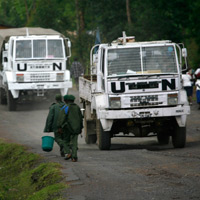
The ongoing operation against the FDLR is code-named Kimia II (Kimia means “calm” in Kiswahili). The offensive was designed to occur in three phases: deployment of Congolese forces, securing civilian areas, and offensive operations to push the FDLR away from strategic locations, such as mines. Starting in June, newly “integrated” Congolese brigades, with logistical support from the United Nations Mission in the Congo, or MONUC, launched attacks on FDLR positions. As U.N. Special Representative of the Secretary General in the Congo Alan Doss told us, “No sovereign state can permit a foreign armed group to control a strategic swathe of territory within its borders.”
However, the Congolese government army is structurally incapable of sustaining coherent military operations against the FDLR. In many places, government army units actively collaborate in commercial dealings with the FDLR, sharing mines and taxation and smuggling opportunities. And according to sources within MONUC, the FDLR still procure arms and ammunition from Congolese army units. As Kimia II heats up, FDLR units are allegedly being tipped off in advance of government army attacks in some locations, allowing them to melt into the forest and wait for more propitious conditions to return. The predatory and fragmented nature of the army even further undermines the military operation, strains the coalition building effort between formerly warring parties, and further terrorizes the civilian population. Some of the Congolese Mayi-Mayi militia fighters that had integrated into the government army after the March 23 agreement are even defecting and now fighting alongside the FDLR. One long-time observer and resident of Congo called the Congolese army a “collection of marauding militias,” whose officers live off the embezzlement of salaries and the minerals trade. A human rights official concluded, “The irony is that the government army was deployed to protect civilians in this operation, but is in fact the biggest abuser.”
The dense rainforest terrain in the Kivus is exceptionally demanding terrain for military operations. Poorly planned and executed attacks on FDLR positions—a near certainty with the Congolese army—will push the FDLR into a familiar operating environment. The FDLR have lived in this mountainous area of 90,000 square miles—an area that houses two national parks and thousands of miles of sparsely populated forest areas that are only accessible by footpaths or poor roads—for nearly fifteen years. Because they have had to remain hidden from other armed groups away from towns, they have come to know this difficult terrain well—better than almost all other armed groups. As one community leader explained, “The CNDP, those who are now supposed to be pursuing the FDLR, don’t know the terrain here. The forest is very deep, and the FDLR know it much better.”
As the military operations unfold, the FDLR’s campaign of reprisal attacks against civilians is intensifying. Like the Lord’s Resistance Army, the FDLR uses asymmetrical warfare, focusing its military attacks largely on civilian populations.[viii] One FDLR commander explained to us, “During the joint operation, many Congolese civilians provided information to the Rwandan army. The FDLR leadership was very unhappy, and retaliated on civilians because they betrayed us. We were instructed to attack civilians for revenge and in order to force the Congolese government army to pull back from our positions.”
A central question must be asked of international support for Kimia II: Does the endgame—removal of the FDLR—justify the means, with so many displaced, raped, looted and killed directly and indirectly resulting from a poorly planned, premature, and limited military-only strategy? The answer is no. There is widespread opposition to these operations from Congolese civilian populations and civil society organizations, as well as the international humanitarian community. It is incumbent on policymakers to force changes that minimize the damage of Kimia II and begin to lay the groundwork for addressing the structural causes of the ongoing violence in a more effective way, including through renewed efforts at political dialogue and a genuine effort to break the war economy.
The creeping toll of sexual violence
Systematic rape has evolved over the last dozen years of war in the Congo as a tool of retribution, social control, or collective punishment against civilian populations deemed supportive of opposing armed groups. As one Congolese woman activist told us, “When they rape the women, they send a message to the men and the community that they have the power and the control. It is designed to humiliate, and to spread HIV/AIDS. And if they capture an area that was under the control of a competing group, they rape and say they are punishing the women because they were spies.”
The United Nations reports that rape cases have spiked since January, coinciding with the beginning of military operations against the FDLR. The main perpetrators are the government army, with a surge of integrated units with infrequently paid ill-disciplined fighters, as well as the FDLR, which has escalated its revenge attacks on areas that it alleges civilians have collaborated with Congolese or Rwandan armies. As a result, rape has become increasingly perpetrated by civilians as well. The cycle of impunity is so ingrained now that violence against women and girls is becoming a way to demonstrate power relations in parts of Eastern Congo.
There are many short-term measures that can be taken by Congolese and international actors to marginally increase the protection of women in Eastern Congo, and these should be fully explored and supported. But we need to be realistic about the limitations. In one of the areas of highest concern regarding sexual violence, Shabunda territory, United Nations officials told us that there are a little over 100 MONUC personnel and a handful of humanitarian officials in an area roughly the size of Rwanda. “MONUC simply doesn’t have the capacity to protect civilians,” one high ranking U.N. official on the ground told us.
Ultimately, a durable peace is the only way to significantly reduce violence against women and its main accelerator, rape as a tool of war. Even women in rehabilitation centers in the East are clear about this. As one survivor told us, “We are dreaming of a stable place to go farm. We fear we will lose all that we are gaining from these programs if there is no peace.” Accountability must go hand in hand with peace, or else the seeds will be planted for the continuation of one of the worst crises of violence against women and girls in the world.
Conflict minerals: fuel for unending war
To understand why conflict in eastern Congo continues to boil with devastating consequences for civilian populations, we have to follow the money trail. The connection between the illegitimate trading and taxation of minerals on the one hand and the deadliest war in the world on the other is direct and undeniable.[ix] Grievances surrounding land and identity—particularly vis a vis Congolese of Rwandan descent—help organize the factions, but greed ensures these conflicts remain violent and unsettled. The government army, rebels, paramilitary militias, and neighboring armies and rebels who double as mafia outfits jockey for control of the mines, trading centers, tax routes, customs rackets, and smuggling opportunities. They fight for the self-imposed right to fleece Congo’s population and natural resource base. One local official told us it is akin to “taxation without administration.”
In Congo, a failed state has been hijacked and is cultivated by a predatory mafia element where what should be state revenue is diverted into personal political and economic fiefdoms. Mineral exploitation pits state-sponsored and militias against each other in competition for the extraordinary rents that accrue to the best positioned. Deep-seated land and identity rivalries create a life or death edge to the jockeying for territorial control. Having access to mines, taxation, transport and smuggling provides the resources for self-defense or offensive actions that ensure “ethnic homeland security.” These rivalries are exploited by governments and militias in Congo and the region in order to recruit or mobilize for offensives. Some of the most violent attacks are linked to land and territorial acquisitions and ethnic rivalries. There is a pre-existing structure of conflict that is fuelled by the mineral business.
The Enough Project has focused to a great extent on the so-called 3 Ts—tantalum, tin and tungsten—that are essential to most of our electronics products. But the illegal trade in gold is also tremendously lucrative for some of the armed groups in eastern Congo. Gold is easy to transport and smuggle, and as its value has gone up on the international market, its attractiveness to armed groups has increased. One FDLR officer told us, “Gold is the easiest way to make money and finance our activities. It is small and easy to buy, transport and sell, and it is impossible to detect.”
By the Enough Project’s reckoning, the armed groups raked in more than $180 million in 2008 through extortion, taxation and smuggling associated with conflict minerals. Instead of drugs and prostitution, these mafia outfits are largely focused on minerals extraction and arms purchases (although some groups have diversified into trafficking charcoal, cannabis, and other commodities). The whole trading chain in minerals is hugely lacking in transparency, making it easy for the shadowy networks to operate and enrich armed groups, and control the trade. Major problems include the following:
- No public map of where the mines are or who controls them: It is difficult to challenge traders who claim their minerals are conflict free.
- No proper list of who trades in the minerals: Only an estimated 1 out of every 10 negociants , or traders who take the minerals from mines to the major cities, have an official license.
- Little transparency around who is regulating the trade: Mining inspectors admitted to us that they knew which sacks of minerals came from FDLR-held mines, but had not been paid for months, so had no incentive to stop this trade.
- Opaque pricing: the comptoirs, or minerals exporters, form an oligopoly to control prices, leaving the rich few to gouge profits from the thousands of miners and smaller traders.
While the government makes some attempt to control the trade, there are clearly serious loopholes that are far greater than in other mining countries. As long as the process remains non-transparent, this largely unregulated trade provides huge opportunities for personal enrichment at each step along the way. The state has become a huge tent in which anyone with the entrance fee is allowed to do business, including war criminals, militias, and white collar predators. You pay, you play.
The illegal mineral trade has a self-sustaining rationale, in which the status quo of insecurity and criminality is maintained in order to maximize profit. “For people around Kabila, the war is a way to make money,” one Congolese observer told us. “They are linked to some of the companies doing the mineral trading, transport and smuggling. They give high level army assignments in Eastern Congo with the expectation that these commanders will send a certain percentage of their profit back to Kinshasa,” thus bypassing state coffers. On the other side of the border, businessmen connected to the regimes in Rwanda, Uganda, and Burundi invest heavily in mineral smuggling operations from the Congo. Inconsistencies in regional taxation schemes further incentivize illegal exports, as export taxes in Congo are significantly higher than in neighboring countries.
The extraordinary deal between Rwanda and Congo was in part a result of the Rwandan government’s desire to displace the FDLR from the mines in the western part of North Kivu and allow the integrated CNDP units within the government army to head up operations against the FDLR and secure these mines. This represents an informal experimental alliance between Kigali and Kinshasa to work together to profit from mineral extraction. The former CNDP does the bulk of the military work against the FDLR in the East, within the context of the government army, the minerals are exported out through Rwanda, the FDLR is slowly dealt out of the game, Rwanda’s involvement becomes more accepted—at least by the Congolese government—and the former state of open warfare is removed, comforting donors that had begun questioning whether to send aid to Rwanda.
Everyone seems to win in this scenario, except, of course, the Congolese people. The FDLR is attacking civilian populations, the same privatized extractive mining operation continues—albeit without the FDLR in some locations—the government army remains predatory, and the people continue to be looted, raped, and exploited.
Congo’s chronic conflict and the constant threat of violence ensures a pliable labor force, a malleable state, and international aid agencies that bring in hundreds of millions of dollars of food and medicine every year to sustain the population. The Congolese government thus shoulders little of the burden to care for its own people takes advantages of further opportunities for private enrichment in the form of rents, transport contracts, and other services. The Congolese people, on the other hand, continue to shoulder the burdens of a horrifying status quo. Until there is shock to this system in the form of greater due diligence at the local, national, regional, and international levels, conflict in Congo will grind on.
The FDLR: still turning a profit
The FDLR remains firmly entrenched in eastern Congo with a presence of about 5,000 to 7,000 fighters and thousands more civilian dependents. The organization continues to finance its activities primarily through the mining of gold and tin, and secondarily through the smuggling of charcoal, the production of marijuana, the taxation of populations in areas it controls, and support from the Diaspora FDLR leadership. We spoke to FDLR officers who confirmed the centrality of mining and taxing minerals to the FDLR’s continued existence. “We could not sustain ourselves without the mineral trade,” one FDLR officer told us. “To survive, the FDLR must have logistics. Minerals are the best way to sustain logistics,” he told us. One Western official in the Kivus explained, “The FDLR claims that it won’t go home because it fears arbitrary justice in Rwanda, but privately the control of resources is their motivation to stay in Congo.”
FDLR officers explained to us that they used the money from the minerals to buy weapons, mostly from the Congolese government army. One officer told us that even after the Rwanda-Congo deal, local Congolese army commanders in the East still provide FDLR units with weapons and ammunition. “The government army wants insecurity to get money,” said one FDLR officer. We also visited village markets in which minerals from mines controlled by the FDLR were being purchased alongside minerals from mines controlled by the government army. We also visited some of the small buyers in Bukavu and Goma where business is done in little shacks and minerals are again purchased without reference to where they originate. There is a whole underground economy that is buying from the FDLR. No statistics or note of origin accompanied these minerals, so right there at the local market the challenge begins to disaggregate which minerals come from which mines of origin.
The Rwandan-Congolese operations at the beginning of 2009 displaced the FDLR from their control of major mining areas in North Kivu, some of which they were able to move back into when the Rwandan government army withdrew. In South Kivu, they continue mining largely untouched by the slow-developing Congolese military offensive, and they have even expanded to control new mining areas.
Five tasks to end the deadliest conflict in the world
The Enough Project believes that a comprehensive international strategy to halt atrocities and end the conflict in eastern Congo must focus on five basic tasks: Protecting civilians, ending the trade in conflict minerals, removing the FDLR, peacemaking at the local and regional level, and promoting accountability.
1. Protect civilians:
Improved efforts to protect civilians and improve security on the ground must be at the forefront of a comprehensive strategy in eastern Congo. Meaningful progress on other tasks will be consistently stymied while civilians are systematically targeted by various armed groups. Necessary actions include the following:
- Donors and governments with military expertise should work with the Congolese government to forge a major multilateral, diplomatically supported, highly human rights conditioned, decade-long commitment to help reform the Congolese army so that it becomes a source of security to the civilian population rather than one of predation. One Congolese civil society leader told us, “If our government and army were stronger and more responsible, then neighbors and corporations couldn’t take advantage of Congo. If we paid our soldiers and fought impunity, no neighboring country would invade or try to take our mineral resources.”
- Recent lessons learned from army reform endeavors in Iraq and Afghanistan should be applied to the Congo. MONUC should further embed personnel in government army units directly, which if systematic can help lay the groundwork in the East for future reform efforts. And given China’s massive stake in the Congolese mining sector, Beijing should be engaged to become a major supporter of army reform efforts, as its contracts will be unstable in the long term without the security a reformed army would afford.
-
The U.N. Security Council should focus MONUC’s capacity specifically to protect civilians in the most vulnerable areas of the East. With the support of the U.N. Security Council and donor countries, MONUC is attempting to increase its civilian protection efforts in the context of Kimia II. The UN is forming “Joint Protection Teams” to bring together different U.N. civilian units and deploy them to vulnerable regions. Because of limited resources and multiple missions, and the enormity of the human security crisis in Eastern Congo, these efforts are in large part a drop in the ocean of need. Ultimately, if civilian protection is going to be the centerpiece of the mandate for MONUC, there has to be a reset on how the mission is deployed, a major increase in the resources it is given to do its job, and a unified interpretation of the mandate and rules of engagement throughout the chain of command.
2. Implement a comprehensive counterinsurgency strategy for the FDLR:
The costs of Kimia II far outweigh the potential benefits. To succeed, civilian damage has to be reduced, the Congolese government army’s discipline and performance has to improve dramatically, the mines have to become subject to the rule of law and transparency, and the military gains against FDLR positions need to be made sustainable. All of these goals are outside the reach of the present Congolese government-MONUC effort. What is needed is a rapid re-think of how to deal with the FDLR, and the creation of a comprehensive counter-insurgency strategy that involves a number of elements that go far beyond the current military-only strategy. It is indeed essential to remove the FDLR from Congo, to reduce human rights abuses there, to restore Congolese sovereign control of its territory, and to remove any pretext for further direct and indirect intervention by Rwanda. Elements of such a strategy are the following:
- The United States and other donors should work with the Rwandan and Congolese governments and MONUC to co-opt moderates within the FDLR.[x] Donors must increase pressure on the Rwandan government to state publicly and precisely which members of the FDLR are wanted for genocide. This information, as well as a greater understanding of the FDLR’s inner-workings, is a prerequisite to an effective strategy to negotiate exit options with individual FDLR commanders. Offers could include resettlement inside Congo—or, potentially, a third country—non-combat positions within the Rwandan army, enhanced livelihood packages, etc. The effectiveness of negotiation would be greatly enhanced if the Rwandan government relaxes restrictions on political activity, and donors should pressure Kigali to make genuine moves in that direction.[xi]
- The international community should fulfill its obligation to sever support to the FDLR inside Congo from its political leaders in the Diaspora. The FDLR has an international network of support, including Diaspora FDLR commissioners, fundraising, and international money transfers.[xii] These and other leaders need to be prosecuted domestically (Europe and the U.S.) and internationally (the International Criminal Court) using every possible legal angle (war crimes, terrorist financing, money laundering, etc.) until Diaspora support for the FDLR becomes so costly that it dries up forever. At a minimum, the United States and other countries should more robustly support the U.N. Group of Experts on the Congo by equipping them with access to necessary personal information held on Diaspora suspects, such as bank accounts, phone numbers, etc.
- The Congolese government should suspend Kimia II and the international community should work with Kinshasa and with MONUC to plan for more effective military pressure on the FDLR command and control structure. Ideally, the United States, France, and the United Kingdom. should plan and mount this operation. Generating the political will for this will be extremely challenging, and less ideal options should also be considered. Although fraught with political risk for the Congolese government, further joint operations by the Rwandan and Congolese armies, this time with the full and active involvement of MONUC and donors, would be more effective in dislodging FDLR from areas it controls. However, effective military pressure without substantial involvement from the United States and European governments remains unlikely until Congo has a more professional, disciplined, and regularly paid army, and there are legitimate concerns that further Rwandan military involvement in Congo will only encourage further cross border adventurism and further entrench illicit Rwandan economic interests in Congo.
- The international community must help the Congolese government to secure and legitimize former FDLR mining operations. Where military operations are successful in displacing the FDLR from individual mines, conditions have not changed dramatically on the ground when the trade remains opaque.
3. End the trade in conflict minerals:
The mines in eastern Congo ultimately need to be secured for legal and transparent exploitation. This will be the main engine of Congo’s economic development. A more integrated and open supply chain—from buyers in Congo (negotiantes) to exporters (comptoirs) to foreign buyers to smelters to electronics and jewelry manufacturers—that demands conflict-free minerals would change the incentive structure away from violence and illegality toward security and rule of law. Only when it becomes more profitable to exploit the minerals legally will there be a sufficient incentive for the peaceful development of the mineral sector. A recent Enough Project strategy paper provided an overview of a comprehensive policy to end the trade in conflict minerals, incorporating corporate responsibility, security measures, governance reforms, and livelihoods initiatives.[xiii]Although this overall approach remains crucial, meaningful change to the mining and minerals trade in eastern Congo must come from the actors within the supply chain. Consumers and companies should demand three necessary steps to enable a transparent trade that benefits the Congolese people:
- Trace: Companies must determine the precise sources of their minerals. Electronics companies and other end-users should support efforts already underway by smelters, metals traders, and other middlemen to develop rigorous means of ensuring that the origin and production volume of minerals are transparent and traceable.
- Audit: Companies should conduct detailed examinations of their mineral supply chains to ensure that taxes are legally and transparently paid to the Congolese government and guard against bribery and fraudulent payments. Beyond financial auditing, companies should monitor social and environmental conditions with the objective of improving these conditions. Companies and trade associations should develop means to engage credible third parties to conduct audits.
- Certify: For consumers to be able to purchase conflict-free electronics made with Congolese minerals, a certification scheme that builds upon the lessons of the Kimberley Process will be required. To be effective and sustainable, such an effort must be owned by the Congolese government, but inclusive of both the private sector and civil society groups. Importantly, Congo and its neighbors have already agreed to support certification under the Protocol against the Illegal Exploitation of Natural Resources of the Pact on Security, Stability and Development in the Great Lakes Region. Donor governments and industry should provide financial and technical assistance to galvanize this process.
4. Promote regional peace and economic cooperation:
The ongoing violence in eastern Congo is in large part a lingering by-product of the war that engulfed the region starting in 1998. Although an internationally-backed peace process led to the official end of the war and Congolese elections in 2006, relations between Congo and it neighbors—particularly Rwanda—have until recently remained severely strained. The delicate détente between Kinshasa and Kigali is the product of a convergence of interests: negotiations between the two capitals that occurred without mediation and absent direct coordinated external pressure.[xiv] What is needed now is deeper diplomatic engagement by the United States and European Union aimed at the further improvement of the relationship between Rwanda, Congo, and other states in the region. Because of its unique position of having strong relations in both capitals, the United States should heavily invest in supporting continued rapprochement between Rwanda and Congo and ensuring a modus vivendi between the two governments, as well as with other neighbors in Kampala and Bujumbura.
Discussions also must occur between regarding regional development issues. Rwandan exports of tin and Ugandan and Burundian exports of gold continue to climb, demonstrating that the trend is toward increased smuggling and extraction by the neighbors. In the short run, a shift toward legal, peaceful production would require harmonization of the export duties among countries in the region, so that Congo’s higher rates don’t by definition drive most commodities across borders illegally into other countries for them to export. And further discussions could occur on a voluntary division of labor between extraction and processing that might leave some room for the neighbors in processing Congolese minerals. A regional economic framework governed by the rule of law is a prerequisite for lasting stability in Central Africa.
5. Promote accountability:
Eastern Congo is, in the words of one MONUC official, an “accountability free zone.” The same could be said for much of the rest of the country. The inability of the Congolese government to adequately investigate, arrest, try, convict, and imprison individuals responsible for crimes against humanity has led to some of the worst atrocities committed anywhere in the world, including systematic and conscience-shocking sexual violence. The problem is immense, and the following steps must be urgently taken:
- Donors should increase investment in the long-term reform of the Congolese justice system so that it prosecutes the warlords who use rape, village burning, and other attacks on civilians as tools of war. This should include both civilian and military justice.
- The U.S. and European Union should make ending violence against women and girls a central part of their diplomatic engagement and aid conditionality with the governments in Congo and Rwanda, instead of stove-piping the issue into a gender programming category. The Congolese government should be held accountable by donors and diplomats for its army’s abuses of women and girls, and Rwanda should be as well for its abuses of civilians – particularly women and girls—in the context of its incursions into Congo and its support for Congolese proxies like the CNDP.
- The International Criminal Court should further target its investigatory efforts on sexual violence in the Kivus, focusing on the command structure in the various armed combatants who encourage rape as a weapon of war.
- The U.N. Security Council and countries with influence such as the United States should focus on countering the incentives for violence as the means of achieving wealth and power in the Congo through the application of sanctions, asset freezes, ICC prosecutions, targeted military operations, diplomatic isolation, focused arms embargo enforcement, and resource export control mechanisms. This should apply to the leadership of non-state armed groups as well as key officials in the Congolese and neighboring governments that continue to undermine peace and protection objectives in the mineral-rich east for their economic enrichment.
Consumer campaigning and activism to drive change
The “blood diamonds” case provides a crucial precedent for activists. Until there was general consumer uproar about the effect Western demand for a precious commodity was having on the people of Sierra Leone and Angola, those conflicts continued to burn, with Western consumers providing all the fuel necessary to keep the wars going indefinitely.
The Congolese buyers (negotiantes) and exporters (comptoirs) have been spooked by the U.N. Group of Experts reports and the possibility of sanctions, which has led them to be more willing to be part of more transparent supply chain procedures if they are introduced. One leading negotiante in South Kivu told us that if he took us to the gold dealers on camera it would cost him his life. A recent report from IPIS, “Culprits or Scapegoats: Revisiting the Role of Belgian Minerals Traders in eastern DRC,” concludes, “… there are indications that the traders under scrutiny are willing to contribute in a more pro-active manner to a sustainable solution to the issue of conflict related minerals. This creates a window of opportunity for all stakeholders to become involved in a concerted effort to enhance transparency and accountability in the mineral sector in the eastern DRC.” The Belgian trader Traxys decided to suspend its mineral purchasing from Congo, something that has greatly upset the local comptoirs and led some of them to proclaim that they would be cooperative in the development of any transparency mechanism. Given this level of concern, now is the time to press for reforms and transparency right down to the mine of origin.
[i] This report results from a trip we took with a CBS 60 Minutes crew to North and South Kivu during June 2009. Ongoing research by Enough Project staff will result in further reports that develop some of the themes in this overview report more deeply. The 60 Minutes episode will run in the fall of 2009. Our visit took us to Bukavu, Burunyi, Walungu, Twangiza mine, and Maroke mine in South Kivu and Goma, Kanyabayungo, and Kiwanja in North Kivu. All of the quotes in the report come from interviews during this trip.
[ii] The cost of humanitarian and peacekeeping assistance to the Democratic Republic of Congo last year was approximately $1.6 billion, while the United Nations Group of Experts looking into support to armed groups cost less than $1.7 million.
[iii] For background on the FDLR, see “Past Due: Removing the FDLR from Eastern Congo,” Enough Strategy Paper by Rebecca Feeley and Colin Thomas-Jensen, June 3, 2008.
[iv] See “Mounting concern as civilians’ plight increases”, International Committee of the Red Cross press release, July 8, 2009.
[v] To learn about Enough’s strategy for ending the LRA insurgency, see “Finishing the Fight Against the LRA”, Enough Project strategy paper by Julia Spiegel and Noel Atama, May 12, 2009.
[vii] Ibid
[viii] See “DR Congo: Massive Increase in Attacks on Civilians”, Human Rights Watch, July 2, 2009
[ix] To learn more about conflict minerals and their connection to atrocities, including sexual violence, in Congo, see Enough’s two strategy papers: “Can You Hear Congo Now?: Cell Phones, Conflict Minerals, and the Worst Sexual Violence in the World,” by John Prendergast, April 1 2009; and “A Comprehensive Approach to Conflict Minerals,” by The Enough Project Team with the Grassroots Reconciliation Group, April 24, 2009.
[x] We have drawn on email correspondence with a noted Great Lakes expert in drafting this section.
[xi] See the work of Human Rights Watch documenting the political situation in Rwanda, including “The Power of Horror in Rwanda”, by Kenneth Roth, April 19, 2009.
[xii] The president of the FDLR, Ignace Murwanashyaka, lives in Germany. He allegedly helped coordinate the FDLR military operations after February 2009, ordering the troops to retreat in the face of the Rwandan army’s January 2009 intervention and then attack civilians when Rwandan forces returned home. Jean-Marie Higiro is the U.S.-based president of the RUD, an allied organization of the FDLR. He is in frequent contact with FDLR generals in the field.
[xiii] See “A Comprehensive Approach to Conflict Minerals.”
[xiv] See “Congo’s Dangerous Crossroads,” Enough Project Statement, January 30, 2009.